
AI research conducted in collaboration with INS Québec selected as a finalist at a prestigious international conference
March 19, 2026
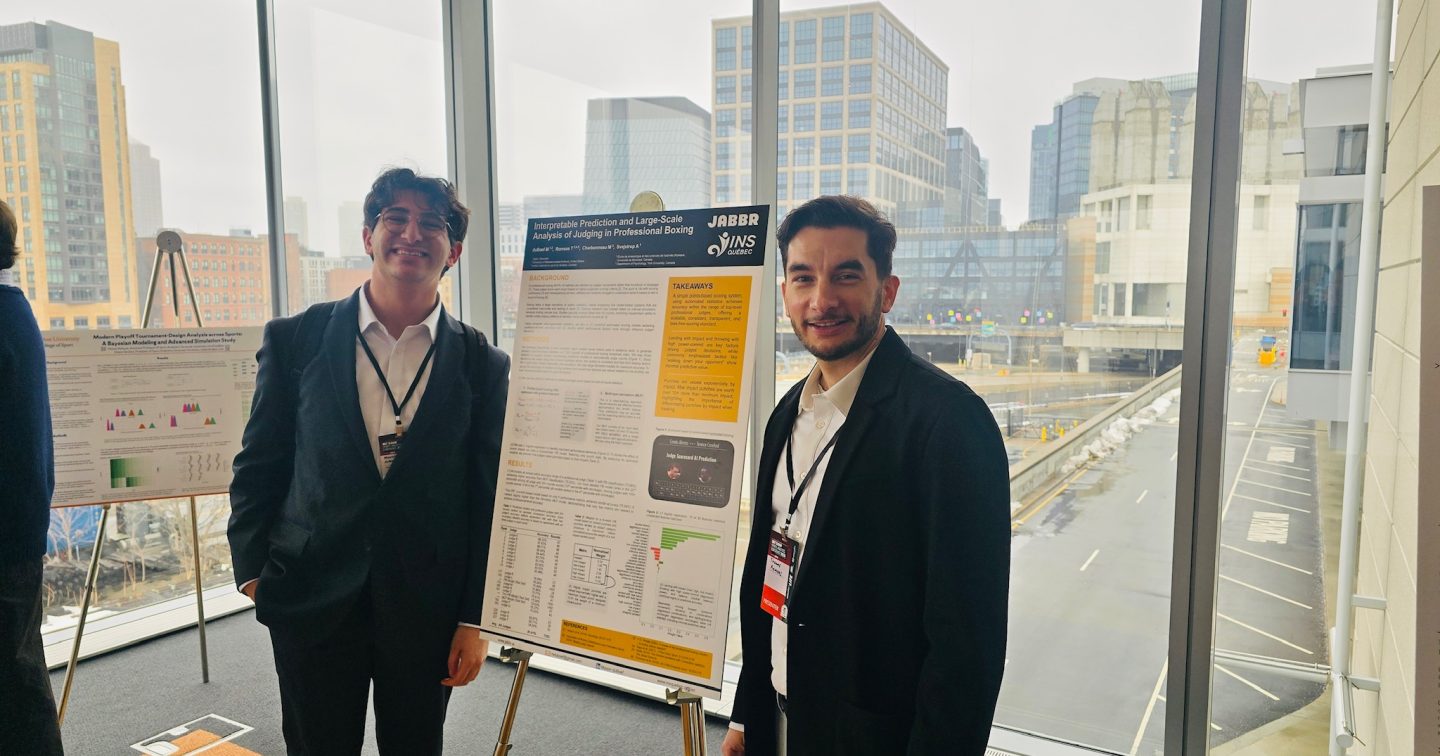
(Photo: Mason duBoef and Thomas Romeas in front of their research poster)
AI RESEARCH CONDUCTED IN COLLABORATION WITH INS QUÉBEC
SELECTED AS A FINALIST AT A PRESTIGIOUS INTERNATIONAL CONFERENCE
The research, titled Interpretable Prediction and Large-Scale Analysis of Judging in Professional Boxing, was selected as a finalist for the 2026 edition of the MIT Sloan Sports Analytics Conference, one of the world’s most prestigious conferences on sports analytics. Out of 197 submissions, the research was one of seven to be presented during the conference. It was co-led by two INS Québec specialists—Thomas Romeas, Lead of Research and Innovation, and Mathieu Charbonneau, sport biomechanist—as well as two experts from the company Jabbr: research intern Mason duBoef and CEO Allan Svejstrup Nielsen.
We asked Thomas Romeas a few questions about the project and his time in Boston.
Photo: Mason duBoef presents the research at the conference.
Your research was selected as a finalist at the MIT Sloan Sports Analytics Conference. What does this recognition mean for INS Québec and for you?
First and foremost, it is recognition of the relevance of the subject being studied—namely, fairness in boxing judging and how artificial intelligence (AI) can help evolve the highly, and sometimes overly, subjective analysis of this sport.
For INS Québec, it demonstrates that the Institute is a key player in research and innovation focused on the use of advanced technologies and AI applied to high-performance sports. This project is also a fine example of collaboration between a technology company (Jabbr) and the Institute’s performance research ecosystem.
Finally, it is a recognition of the collective work carried out with our partners and the student involved in the project. This positions INS Québec as a partner of choice for developing innovation and AI in sports. It also recognizes the expertise of the Institute’s members in performance analysis, particularly in boxing and AI.
What is the research topic?
The research focused on the automated analysis of boxing matches using artificial intelligence.
Using computer vision—an AI method that interprets video pixels into measurable events—we analyzed over 7,000 rounds of professional fights to automatically extract performance statistics (types of punches, attack volume, accuracy, etc.). The data used came primarily from publicly available videos of professional fights online, particularly on YouTube.
The goal was then to determine to what extent this data can predict judges’ decisions and identify which performance criteria actually influence boxing judging.
What are the main findings?
The results show that artificial intelligence models can predict the outcome of a fight with an accuracy comparable to that observed among experienced human judges recognized within the sports community, but in an automated and transparent manner.
The major benefit is that these models also provide a better understanding of the criteria that influence judging, which brings a degree of transparency to a sport often criticized for its refereeing decisions.
For example, the analysis shows that certain types of punches and offensive actions carry much more weight in the evaluation of a round than others. The analysis also debunked certain myths regarding specific performance metrics that were previously thought to be crucial to the outcome of a fight.
How can these results help boxers?
These results can benefit boxing in several ways.
First, this type of tool could reduce certain biases in judging by providing referees with a decision-making aid based on objective metrics, which would allow athletes to be judged fairly.
Second, from a performance perspective, these technologies could enable athletes, coaches, and scientific teams to conduct performance analyses much more quickly. This could help better understand a boxer’s strengths and weaknesses, as well as analyze future opponents.
How was AI used in the research?
It was used in three main ways.
First, a computer vision algorithm (DeepStrike) developed by the company Jabbr enabled the automatic analysis of boxing matches and the extraction of performance data on a large scale, covering over 7,000 rounds. This is unprecedented in the sport and in the scientific literature on the sport.
Second, we used various algorithmic approaches to compare AI predictions with actual judges’ decisions, testing both interpretable models and more complex neural networks.
Finally, statistical models were applied to identify the metrics most influential on judges’ decisions. This exercise helped determine which metrics are more and less important for declaring a boxer the winner at the end of each round.
Do you think this type of tool could transform the way coaches or judges analyze performance?
I think these tools should be seen as a complement to human judgment, not a replacement.
AI can provide a very objective analysis based on performance metrics, even though there’s always a margin of error, but coaches and referees also observe elements that technology can’t yet capture well, such as body language, signs of fatigue, or pain.
The ideal scenario would therefore be a combination of objective data analysis and human expertise, as is currently happening in several other sports, such as VAR in soccer, Hawk-Eye in tennis, or the ABS system in baseball. Boxing, however, remains a very traditional sport that has historically evolved more slowly in terms of technology, making the integration of this type of innovation more difficult.
How might the boxing world use this type of analysis in the coming years?
There are several possibilities.
First, the algorithm can be further improved through more data and training to increase its accuracy and robustness.
Second, this type of tool could serve as a decision-making aid for referees while providing greater transparency for fans.
From a scientific and athletic perspective, these technologies could also be used by teams to track boxers’ performance over time, analyze fighting styles, or better manage the impact load during training to protect athletes’ long-term health, given the health risks associated with repeated exposure to impacts.
Finally, similar sports such as MMA or other combat sports could also benefit from this type of approach.

Photo: Thomas Romeas in Boston.
What did you take away from your experience at the MIT Sloan Sports Analytics Conference?
What struck me was the very interesting blend of science, business, and sports management. These three fields are increasingly converging through the use of data and are helping to improve the world of sports.
The conference also highlights the growing importance of developing a basic understanding of data science, even with relatively modest data volumes, as this field will play a major role in the evolution of sports in the coming years.
Ultimately, this confirmed to me that INS Québec, which has been using AI since 2017, is now very well positioned to play a pivotal role in the development and integration of artificial intelligence in sports in Québec and Canada.